Muscles are fibrous tissue that bonds move your body, guard posture, and the Functioning of the Internal Organs, such as the heart, kidneys, and bladder. The functions were performed by three types of muscle (right), in which the muscle framework the most part.
Muscles are controlled by signals from the nervous system. Framework muscle can be consciously controlled, whereas other muscles work automatically. Most muscle framework, linking the two adjacent bones. One end of the muscle bound with string bending fiber network, called the tendon, while the other end attached to a tendon or a related network. Muscles not only move the framework of the body, it also helps keep our posture when standing, sitting, or lying down. Name some muscle to show their function. Extensors to straighten the joint, bending the joint flexor, adductor moves toward the body member, Abductor move away from the body's limbs, and establish or erektor to hold parts of the body. Some of the muscles described in the framework of the left side of the picture and the muscle is located more outside listed on the right.
Wednesday, October 7, 2009
Muscle
Spinal
Spine, also called the vertebral column, keeping the body upright position, supporting his head, and closed and protect the spine nerves. Consists of 33 bones called vertebrae.
Joints and discs made of fibrous material between the most spinal vertebrae can create flexible, while the ligaments and muscles to stabilize and control the movement.
Framework
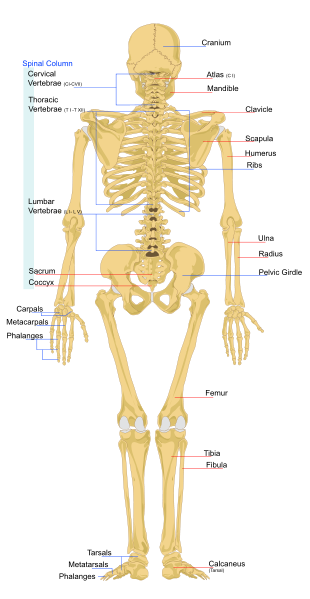 The framework served to form, sustain, and protect the body. Consists of 206 bones, plus a bone-prone (type of fibrous material and ductile). Axial skeleton-skull, spine, and ribs, consists of 80 bones and protect bone apendikular has consisted of 126 bones of limbs, clavicle, scapula, and pelvic bones. The whole bone is living tissue with cells that continually renew old bone with new material. Bone containing soft fatty material (marrow) which is surrounded by porous bone, which is also surrounded by more dense bone. Marrow in the spine, skull, ribs, pelvis and duty to produce blood cells.
